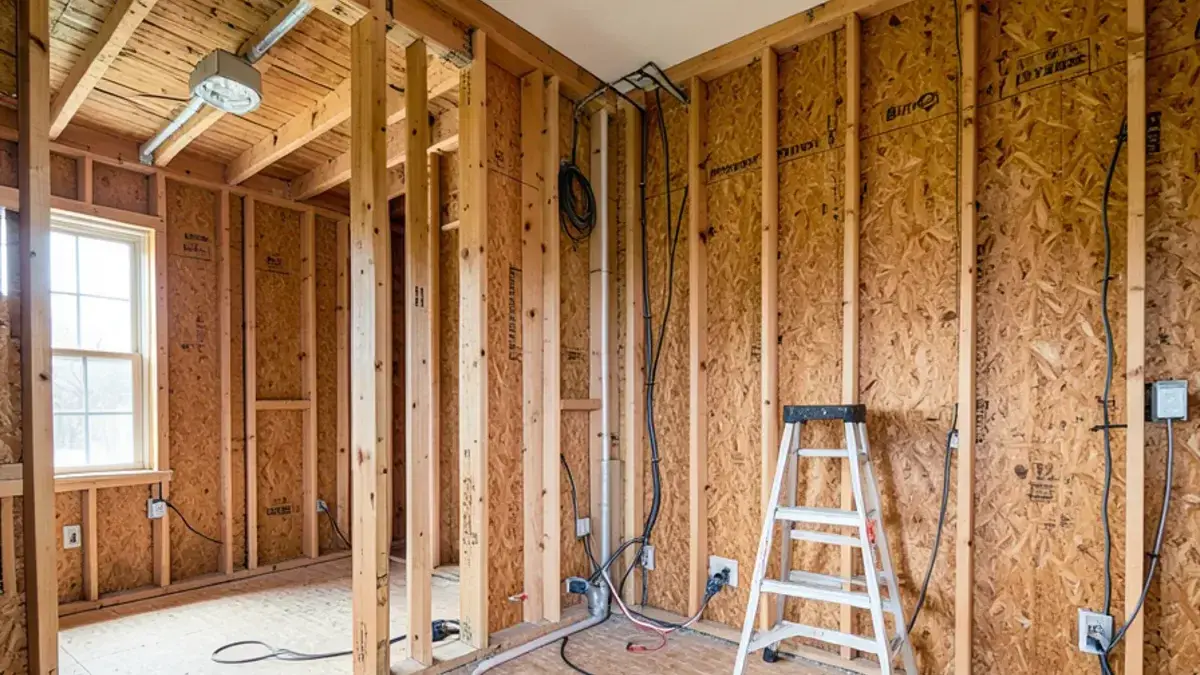
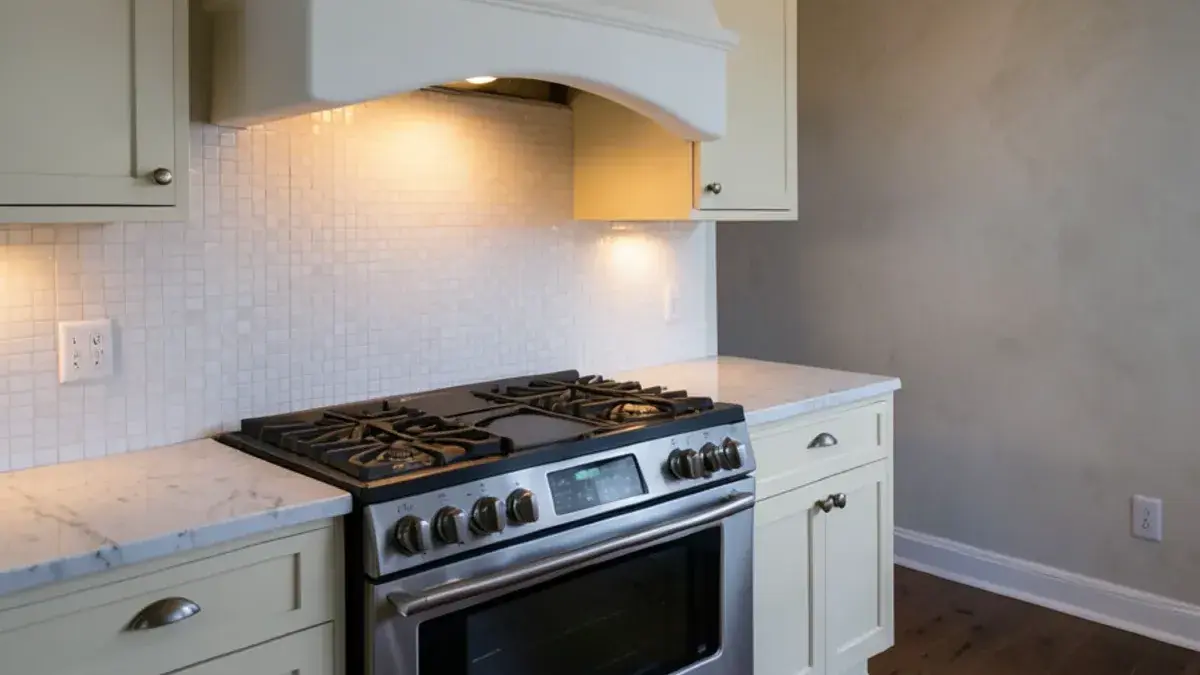
A custom range hood in Pinckney, MI is often the largest design element on the cooking wall, and it has to clear smoke and grease as well as it looks; in tightly built newer Livingston County homes, a strong hood can also pull air back down a flue. Nick designs hoods with the rest of the kitchen cabinets from the first drawing.
A custom hood has two parts: a decorative cover in wood, plaster or metal, and a ventilation insert that does the work. Below: sizing, ventilation, make-up air in Michigan homes and coordination with your cabinetry.
Is your current range hood actually venting the kitchen?
Many kitchens around Pinckney were built with ventilation that only looks like ventilation. Older lake cottages and 1970s ranches often have a recirculating fan, and many 1990s–2000s homes have an over-the-range microwave that pushes grease back at the cabinets. Signs it is time for a properly ducted hood:
- A sticky film on the upper cabinets and ceiling near the range
- The smoke alarm sounds every time someone sears a steak
- Cooking smells reach the bedrooms by evening
- The duct ends in the attic or a soffit instead of outdoors
- Frost or drips at the wall cap during a January cold snap
What you get: custom range hoods with Kitchen NV
- Hood width, depth and mounting height drawn to your cooktop and the manufacturer's requirements
- Cover design in wood, plaster or metal, shown in elevation and 3D
- Insert selection with airflow sized to your range, not to the largest number on the box
- A duct route to the exterior marked on the drawings for your contractor
- A make-up air flag when the planned hood exceeds the code threshold
- Finish coordination so a wood hood matches or deliberately contrasts with the cabinets
How large should a custom range hood be for your cooktop?
Smoke and steam spread as they rise, so the hood needs to span the full cooktop. Over powerful gas burners, designers often add a few inches per side, and island hoods need extra width because cross-drafts push fumes sideways. Front burners must sit under the hood's footprint as well.
| Situation | Width guidance | What else to check |
|---|---|---|
| 30-inch electric or induction against a wall | At least 30 inches, often 36 | Mounting height in the insert instructions |
| 36-inch gas range against a wall | 36 inches minimum, often 42 | Front-burner coverage and depth |
| 48-inch professional range | 48 inches minimum, often 54 | Airflow, make-up air and duct size |
| Cooktop in an island | Wider than the cooktop on all sides | Ceiling support and a duct path above |
Mounting height comes from the insert manufacturer, commonly 30 to 36 inches above the cooktop.
Planning custom range hoods? Call Nick at (810) 923-8792
Call Kitchen NV in Pinckney, Monday to Friday, 9 a.m. to 5 p.m. Design consultations are by appointment.
- ★ 5.0 on Google (28 reviews)
- MI Residential Builder #2101209269
- CMKBD · CAPS · CLIPP designer
- Serving since 2020
Wood, plaster or metal: choosing a custom vent hood cover
Wood range hoods
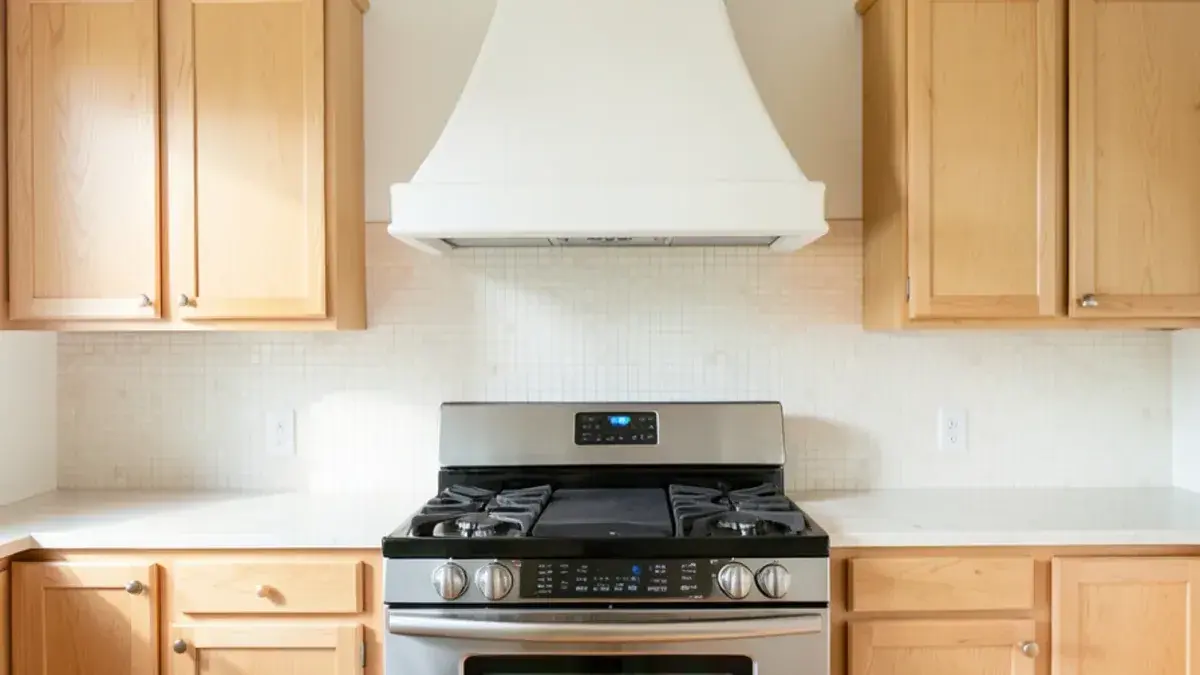
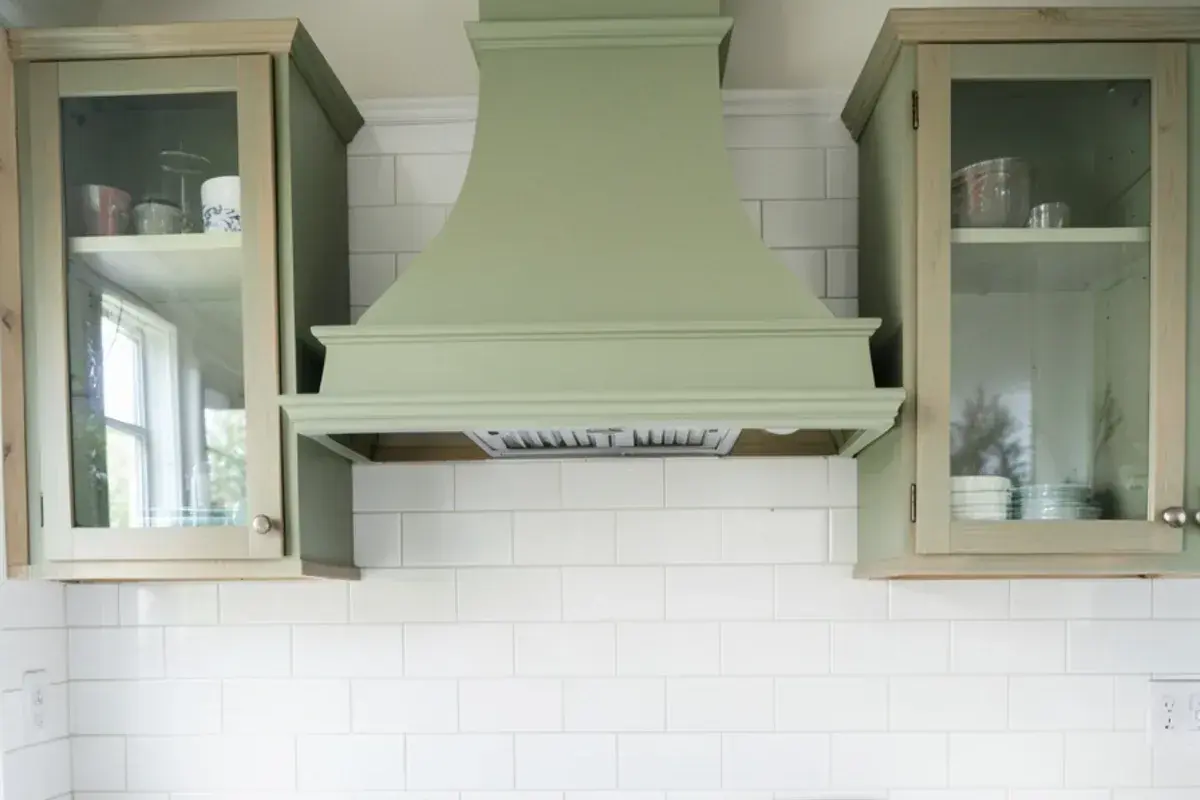
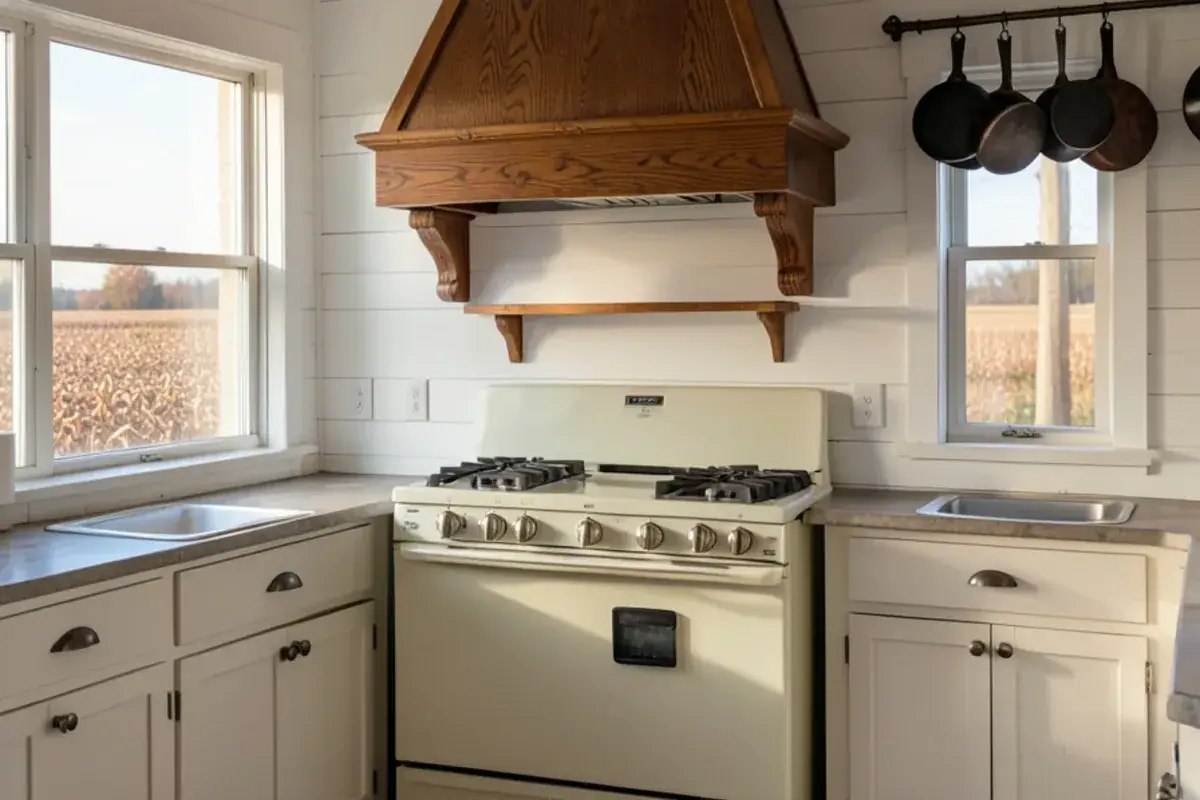
A wood hood is built like a piece of cabinetry, so it can be painted or stained to match the surrounding boxes or finished in a contrasting tone. Styles range from a simple tapered box to corbels, a mantel shelf or a straight shaker frame. Because it is ordered with the cabinets, the finish matches the way the doors do.
Plaster range hoods
Plaster hoods are formed over a framed structure on site, or set from a precast shell, then troweled smooth or textured. They suit European, Mediterranean and modern farmhouse kitchens and can curve in ways wood cannot. Plaster needs a skilled finisher and curing time in the schedule.
Metal range hoods
Stainless, copper, brass and zinc read professional or rustic. Unlacquered brass and copper patina over time, so Nick shows aged samples first.
Range hood ventilation: CFM, inserts and ductwork
Inside every custom cover sits an insert, sometimes called a liner or power pack, with the blower, filters and lights. Its airflow is rated in cubic feet per minute (CFM). A common rule of thumb for gas ranges is about 100 CFM for every 10,000 BTU of total burner output, while electric and induction cooktops generally need less. Bigger is not automatically better: more CFM adds noise and can trigger make-up air rules.
- Duct outside, never into the attic. Exhaust should terminate at an exterior wall or roof cap with a backdraft damper.
- Keep runs short and smooth. Fewer elbows and the duct diameter the insert maker specifies keep airflow close to its rating.
- Plan for Michigan winters. A tight damper limits cold drafts, and duct through unheated space is usually insulated to reduce condensation.
- Choose filters you will clean. Baffle filters suit heavy searing and frying and go through the dishwasher.
What moves the cost of a custom hood
The cover material sets the first number: a wood hood ordered with the cabinets, a plaster hood framed and troweled on site, or a metal hood fabricated to size. Then come the insert's airflow and blower type, the length of the duct run and whether it exits through a wall or the roof, ceiling framing to carry an island hood, a new electrical circuit and, above 400 CFM, a make-up air system. Each is priced as its own line.
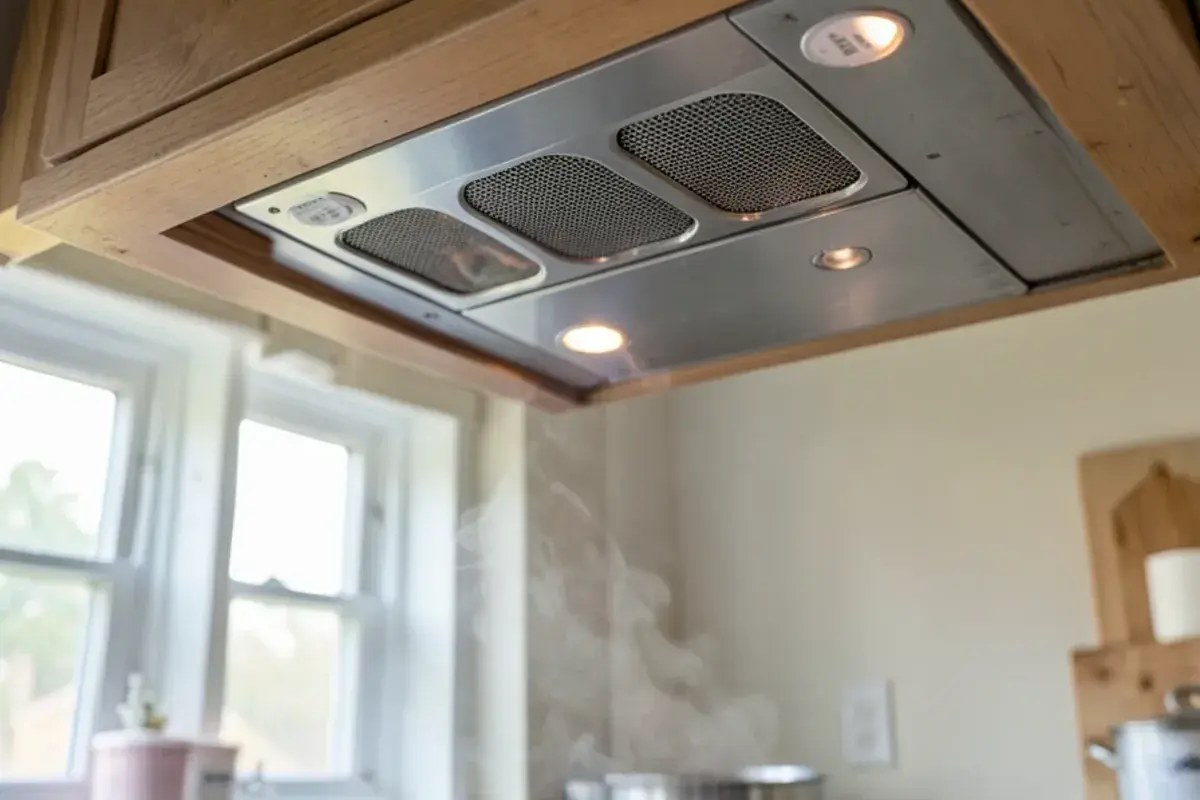
Does a powerful hood need make-up air in a Michigan home?
Often, yes. The Michigan Residential Code adopts the IRC's make-up air rule (section M1503.4 or M1503.6, depending on the edition in force): once a hood is rated to pull more than 400 CFM, replacement air must come in at roughly the same rate, typically through a motorized damper that opens whenever the hood runs.
The reason is practical: a strong hood in a tight house can pull air back down a fireplace flue or water heater vent. Local rules vary, so confirm them with your building department and let your HVAC contractor size the system. Who pulls which Michigan kitchen remodel permit is covered on the blog.
Mechanical permits and who does the duct work
Cutting a duct through a wall or roof and adding a make-up air damper count as mechanical work, and the hood circuit is electrical, so expect two permits. The county office in Howell covers most Livingston townships, but Green Oak, Brighton (city) and Howell (city) permit their own work. Hoods also call for two kinds of license: MCL 339.2403 covers paid residential jobs of $600 or more, and ductwork belongs to a contractor with a state mechanical license. Nick, licensed as a residential builder (#2101209269), marks the route on the drawings for them.
Custom range hoods in Pinckney, MI, designed with the cabinetry
Because the hood is usually the focal point, its proportions are set together with the wall cabinets around it: how high the uppers run, whether they stop at the hood or wrap it, and where the duct chase hides. On custom kitchen cabinets the hood can be built by the same shop; with semi-custom cabinets, a matching wood hood is often available from the line, or a plaster or metal hood becomes a deliberate contrast.
Lighting belongs in the same conversation. Hood lights cover the cooktop, but the wall still needs task light; see kitchen lighting design for how those layers are planned.
“Nick is unbelievably talented. He has an eye for detail. Brought in samples of everything. Sat down with me and spent as much time as was needed. Never felt rushed. Told me how much everything was going to cost. I made the decision. No … More ”
How a custom hood moves from sketch to install
Cooking conversation
Nick asks how you cook, which range you are considering and how the house is heated and vented.
Size and style
Once the design retainer is signed, the hood is drawn in elevation and 3D at the right width, depth and height, with cover options to compare.
Insert and duct plan
An insert is matched to the range, and a duct route to the exterior is marked for your contractor.
Make-up air check
If the hood exceeds 400 CFM, Nick flags make-up air early so your HVAC contractor can size and permit it.
Order and coordinate
Wood hoods are ordered with the cabinetry; plaster and metal hoods are scheduled with the finisher or fabricator.
Install support
Nick stays involved while the installer, electrician and HVAC contractor set the hood and connect it.
Why Kitchen NV designs the hood with the cabinets
Part of the selections package
Custom vent hoods have been a standard part of Kitchen NV's selections work, chosen alongside tile, lighting and plumbing fixtures.
Builder-licensed planning
Duct routes and framing are worked out before the cover is built, by a designer who is also a Michigan-licensed residential builder (#2101209269).
Designer's eye for proportion
Nick's CMKBD training from the NKBA shows in how he weighs a hood against cabinets, windows and ceiling height.
Samples in your kitchen
Wood finishes, plaster textures and metal patinas are reviewed in your own light, by appointment.
Warranty coverage on cabinetry, countertops, fixtures and installation comes from each manufacturer and the installing contractor; you receive their written terms before anything is ordered.
Where we work
Nick designs custom hoods for kitchens in Novi, Saline, Unadilla Township and Highland Township, from tight new-construction homes that need make-up air planning to farmhouses where a stained wood hood fits the history of the house.
- Highland Township, MI
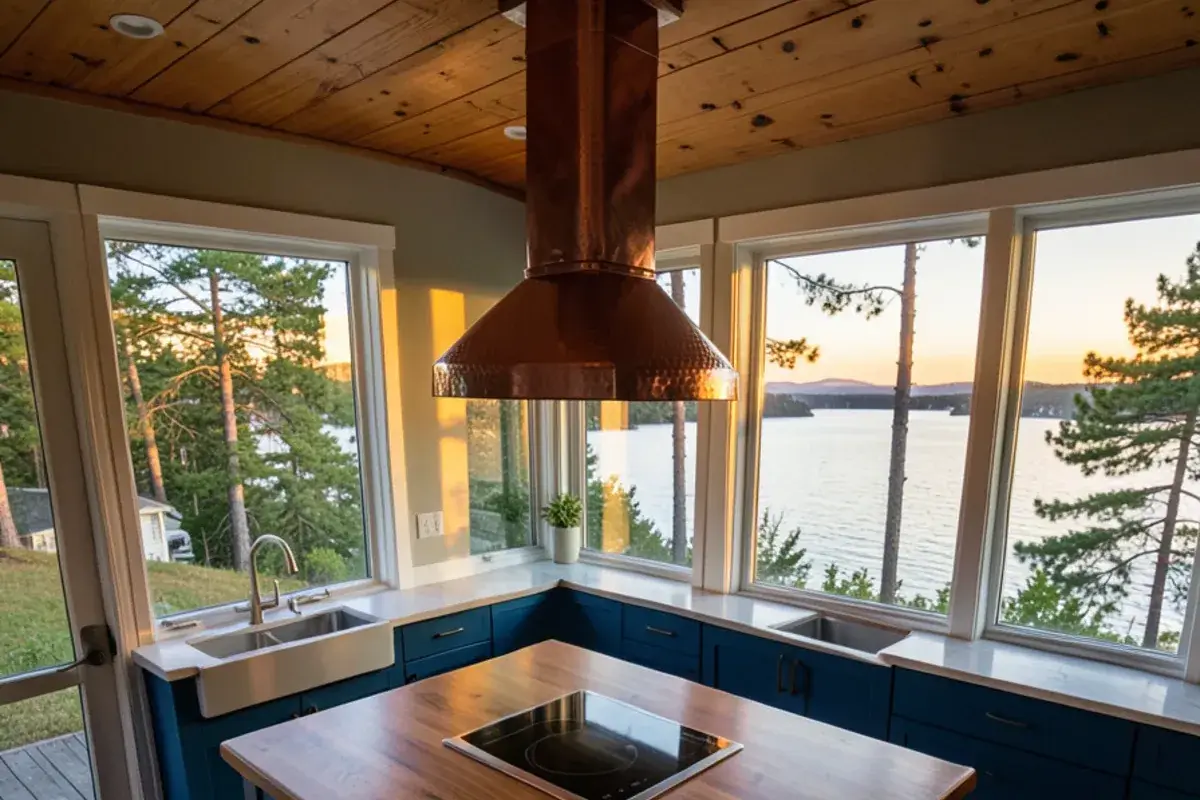
Duck Lake and wooded-lot homes where island cooktops facing the view need wide hoods and a roof duct.
- Hartland Township, MI
Large homes on wooded lots along M-59, often with professional ranges whose airflow tips them into make-up air territory.
- Dexter Township, MI
Lake homes north of Dexter with wood stoves or fireplaces, where an oversized hood can pull smoke back down the flue.
- Tyrone Township, MI
Lake Tyrone and Runyan Lake houses, many converted from cottages that never had a hood ducted outdoors.
- West Bloomfield Township, MI
1970s–1990s homes near Orchard and Pine lakes, where a plaster or metal hood often replaces a dated soffit-mounted fan.
- Ann Arbor Township, MI
Wooded properties near Barton Hills, where custom kitchens often center the cooking wall on a statement hood.
- Lodi Township, MI
Newer estate homes on acreage, built tight enough that make-up air belongs in the plan before the range is chosen.
- Milford, MI
Older downtown houses where a duct route through plaster and old framing needs planning early.
- Chelsea, MI
Historic downtown homes where a stained wood hood can tie new cabinetry to older trim.